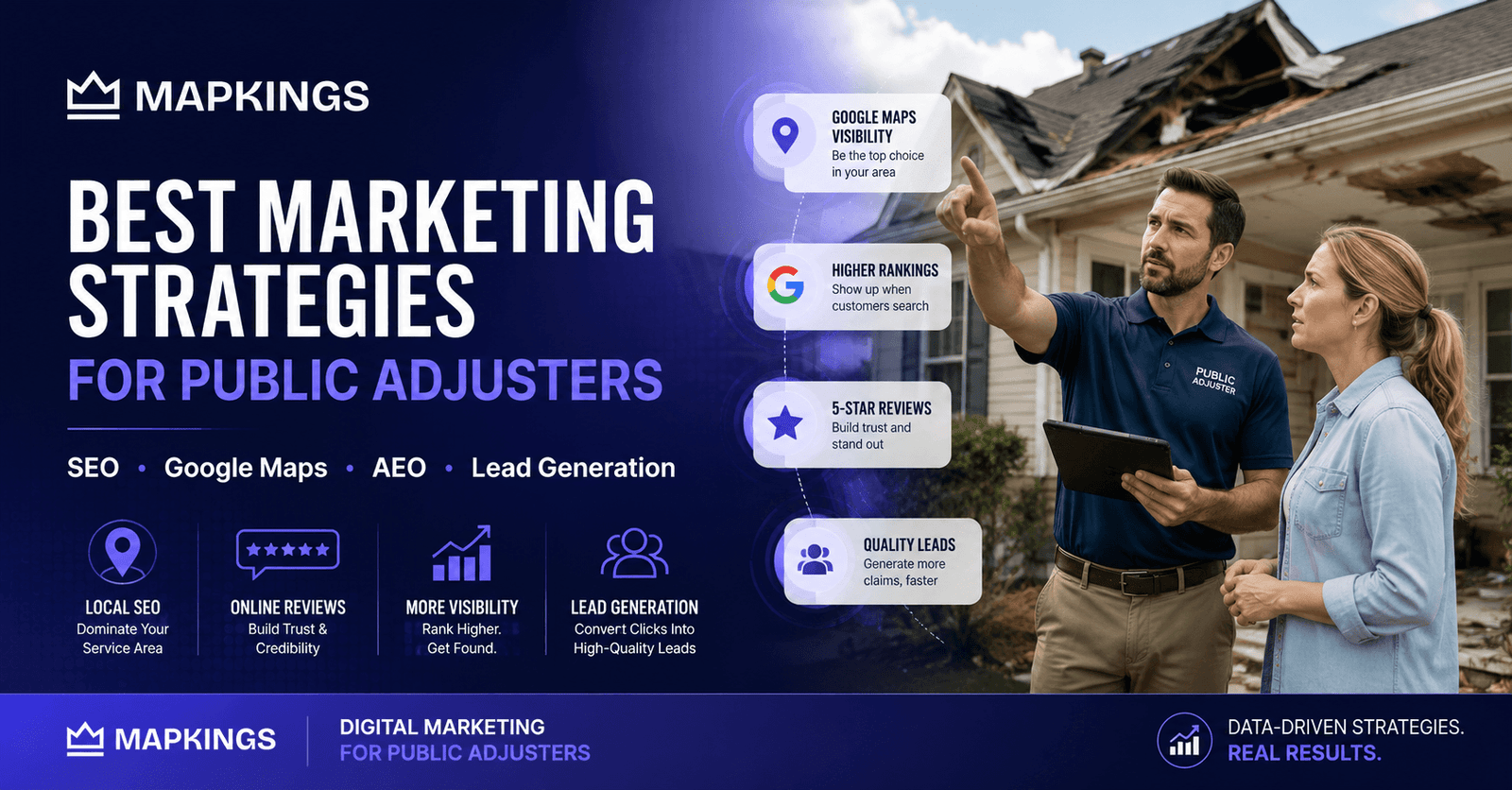
Map Kings helps public adjusters rank higher on Google Maps, show up for high-intent property claim searches, and build the kind of online authority that makes homeowners, commercial property owners, and policyholders trust your firm before they contact you.
If your public adjusting firm depends on referrals alone while competitors dominate searches like “public adjuster near me,” “denied insurance claim help,” “roof damage public adjuster,” and “underpaid claim help,” you are losing some of the highest-intent leads in your market.
A strong public adjuster may have years of claim experience, real settlement knowledge, and great client outcomes. But if Google cannot clearly understand where you work, what claims you handle, and why policyholders should trust you, your competitors will get the calls first.
We optimize your Google Business Profile, website, city pages, service pages, and local authority signals so your firm can compete in Google Maps and organic search.
We build SEO around the searches that matter: denied claims, underpaid claims, roof damage, water damage, fire damage, hurricane claims, and commercial property claims.
Ranking is not enough. Your page has to make a stressed policyholder believe you are credible, responsive, licensed where required, and capable of helping with the claim process.
Public adjusting is a trust-heavy, regulation-sensitive, event-driven industry. A weak SEO campaign treats your firm like any other local service business. That is not good enough. Your SEO must explain your claim expertise, your service area, your licensing language, your damage specialties, and your process in a way that both Google and policyholders can understand.
One generic page that says “we help with insurance claims” with no claim-type depth, no city strategy, no Google Business Profile alignment, no FAQ schema, no proof sections, and no clear reason for a policyholder to contact the firm.
A full local search system built around Google Maps, service-area relevance, claim-type pages, storm-damage content, review strategy, internal linking, AEO answers, schema markup, and conversion-focused page design.
A homeowner searching “public adjuster near me” may be ready to call. A property owner searching “insurance company denied my roof claim” may need education first. Your SEO should capture both: urgent map-driven leads and research-driven claim leads.
| Search Intent | Example Keywords | Best SEO Asset | Why It Matters |
|---|---|---|---|
| Immediate local help | public adjuster near me, public adjuster in [city] | Google Business Profile + city page | These are high-intent searches where Google Maps visibility can drive calls fast. |
| Denied claim help | denied insurance claim help, denied roof claim public adjuster | Denied claim service page | Policyholders need clear next steps, trust, and a reason to contact a specialist. |
| Underpaid claim help | underpaid insurance claim, low insurance settlement help | Underpaid claim guide + FAQ | These searchers are frustrated and often comparing experts before taking action. |
| Storm and hurricane damage | hurricane damage public adjuster, storm damage claim help | Storm damage location page | After major weather events, search demand spikes and local authority matters. |
| Property damage type | water damage public adjuster, fire damage public adjuster, roof damage claim help | Damage-specific service pages | Google needs to understand the exact claims your firm handles. |
| Commercial claims | commercial public adjuster, business property claim adjuster | Commercial claims page | Commercial claim searches can be higher value and require stronger authority signals. |
We do not build thin pages and hope Google figures it out. We build a structured public adjuster SEO system that connects your Google Business Profile, website, claim services, city pages, reviews, content, and schema into one clear local authority signal.
We improve categories, services, descriptions, photos, posts, Q&A, service areas, review positioning, and conversion elements so your profile is built to compete in local search.
We strengthen relevance, distance, and prominence signals by aligning your website, local content, business profile, citations, reviews, and service-area strategy.
We build or improve pages for roof damage, water damage, fire damage, storm damage, hurricane claims, flood claims, denied claims, underpaid claims, and commercial claims.
We create localized pages that target your strongest markets without sounding copied, spammy, or generic. Each city page must have real local relevance and claim-specific value.
Public adjuster leads are cautious. We help position reviews, testimonials, case-style proof, and trust signals in a way that supports both ranking and conversion.
We structure your content so Google AI Overview, ChatGPT, Gemini, and other answer engines can better understand your services, locations, claim expertise, and FAQs.
Public adjuster marketing cannot sound reckless. The wrong page can overpromise, make unclear claims, or fail to explain the firm’s role properly. Map Kings builds content that is persuasive, but also careful with claim language.
Your page should clearly explain that a public adjuster represents the policyholder in the property insurance claim process, not the insurance company.
Public adjuster rules vary by state. Your SEO pages should use accurate licensing language for the markets you serve and avoid vague nationwide claims where they do not belong.
We avoid weak, risky language like “guaranteed bigger settlement.” Instead, we focus on process, documentation, policy review, negotiation support, claim preparation, and experience.
Your website should not be a digital brochure. It should be a local authority hub that explains what claims you handle, where you work, what policyholders should know, and why your firm is the obvious next call.
Build dedicated pages for water damage claims, roof damage claims, fire damage claims, hurricane claims, storm damage claims, flood claims, denied claims, underpaid claims, residential claims, and commercial property claims.
Create high-quality city pages for every serious market. Each page should include local claim risks, common property damage issues, service-area details, FAQs, and internal links to related claim services.
Publish content around what to do after a claim denial, how to document property damage, what underpayment means, how public adjusters are paid, and when policyholders should ask for help.
Link city pages to claim pages, claim pages to FAQs, blogs to service pages, and your Google Business Profile landing pages to your highest-converting pages.
Search is moving beyond blue links. Policyholders ask direct questions like “should I hire a public adjuster for a denied roof claim?” or “who can help with an underpaid insurance claim near me?” Your website should be structured so search engines and AI tools can extract clear answers from it.
We add clear FAQ sections that answer real policyholder questions and help search engines understand your expertise.
We use structured data to clarify your public adjuster services, claim categories, service areas, and page purpose.
We make your brand easier to understand by reinforcing your name, services, locations, claim types, and authority signals across your site.
The goal is not to make your website “look active.” The goal is to build a ranking system that generates qualified policyholder leads from Google Maps, organic search, and AI-assisted search.
We review your rankings, competitors, Google Business Profile, service pages, reviews, city coverage, content gaps, citations, and conversion path.
We identify the highest-value searches by claim type, city, urgency, property type, and policyholder problem.
We strengthen business information, services, posts, Q&A, photos, descriptions, and review positioning.
We create service pages, city pages, claim guides, FAQs, internal links, and schema markup that support your SEO goals.
We improve local signals through content structure, citations, internal linking, review strategy, and relevant authority-building assets.
We monitor rankings, traffic, Google profile actions, call opportunities, keyword movement, and the pages driving the most demand.
These are the questions public adjusters usually ask before investing in SEO, Google Maps optimization, and AI search visibility.
Local SEO for public adjusters is the process of optimizing a public adjusting firm’s website, Google Business Profile, service pages, city pages, reviews, local listings, and content so the firm can rank higher when policyholders search for claim help in their area.
Many policyholders search with local intent when they need help with a denied, delayed, underpaid, or complicated property insurance claim. Google Maps SEO helps your firm appear where people are already looking for nearby claim support.
Public adjusters should target broad local keywords like “public adjuster near me” and “public adjuster in [city],” plus claim-specific keywords such as denied insurance claim help, underpaid claim help, roof damage public adjuster, water damage claim help, fire damage public adjuster, hurricane claim help, and commercial public adjuster.
Yes. Separate service pages help Google understand the specific claims your firm handles and help policyholders find information that matches their problem. Important pages may include roof damage claims, water damage claims, fire claims, hurricane claims, denied claims, underpaid claims, and commercial property claims.
Yes, but only if they are built properly. Thin city pages with copied text are weak. Strong city pages explain the local market, claim risks, nearby service areas, damage types, FAQs, and why policyholders in that city should contact your firm.
Yes. A strong SEO strategy can attract policyholders searching for specific claim help instead of broad, low-quality traffic. The best campaigns focus on urgent, local, and claim-specific search intent.
SEO timing depends on the market, competition, website quality, Google Business Profile strength, review profile, content depth, and current rankings. Many public adjuster campaigns need several months of consistent work to build meaningful visibility.
Yes. AEO helps your firm become easier for Google AI Overview, ChatGPT, Gemini, and other answer engines to understand. Public adjuster pages should answer questions clearly, use structured data, and explain services in direct language.
Yes. Map Kings builds local SEO systems for service businesses that need stronger visibility, better Google Maps performance, sharper service pages, and more qualified leads from local search.
If policyholders in your market are searching for public adjusters, denied claim help, underpaid claim help, roof damage claims, water damage claims, storm claims, or commercial property claim support, your firm should be one of the first credible options they find.
Map Kings - All Rights Reserved.
 MAPKINGS